
Have You Ever Noticed Countless Tiny Space Craft Passing Right Above Your Neighborhood Every Day
Most people walk through daily routines without realizing how closely ordinary space operations tie to their morning commutes, grocery runs and weekend leisure plans.
When you unlock your phone to check navigation on the way to grab your usual morning latte, or pull up a weather radar to decide if you should bring an umbrella for your after-work walk, you are not just connecting to nearby cell towers and ground-based server farms. Hundreds of low-orbit spacecraft are zooming 300 to 500 kilometers above your head at a speed faster than a rifle bullet, sending real-time data straight to your device to make those tiny daily conveniences work. On clear nights far away from heavy city light pollution, you can even spot these small craft with your naked eyes: they look like slow-moving bright points of light drifting across the starry sky, much steadier and slower than shooting stars, and many casual stargazers mistake them for unidentified flying objects before they learn the truth.
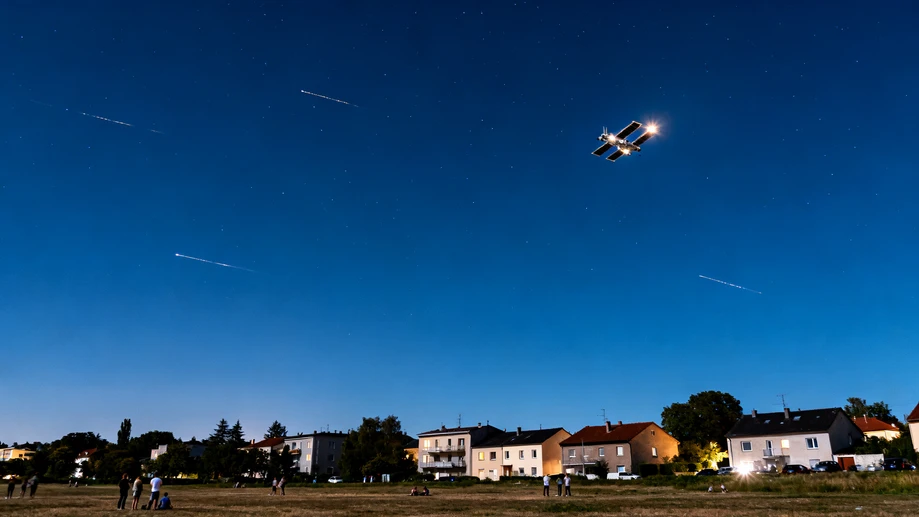
Tracking these overhead visitors is a hobby accessible to almost everyone, with zero need for expensive professional telescopes or advanced aerospace knowledge. Free, user-friendly mobile applications calculate the exact time when a specific satellite will pass over your residential area, alert you a few minutes in advance so you can step outside and look up to catch the moment. The largest man-made object flying in low orbit, the International Space Station, is bright enough to be spotted even in moderately lit suburban areas, its solar panels reflecting sunlight so strongly that it looks like a glowing plane flying across the sky with no audible engine noise. Many casual hobbyists manage to capture sharp photos of it crossing in front of the moon during special predicted alignment events, using nothing more than a regular smartphone camera paired with a cheap consumer tripod.
The distance between you and the astronauts living on the International Space Station is actually shorter than the driving distance between most pairs of adjacent major cities in many countries. Traveling at roughly 7.7 kilometers per second, the station circles the entire planet every 90 minutes, which means the crew inside gets to witness 16 separate sunrises and 16 sunsets over the course of a single 24-hour day. They often take casual photos of populated residential areas through their observation windows during their breaks, and there is a tiny, random chance that you might end up in the background of one of these shots if you happen to be walking around your neighborhood at the exact moment the station flies overhead, completely unaware that a camera hundreds of kilometers up is pointed in your direction.
There is a common misconception that all aerospace projects are distant, ultra-expensive ventures that have nothing to do with ordinary people’s daily lives, but this belief ignores how deeply integrated space infrastructure is with even the most trivial routines. The earthquake alert that pops up on your phone seconds before shaking reaches your area, the updated wind speed data that helps your commercial flight avoid unexpected turbulence, the smooth high speed internet signal that reaches remote mountain villages with no ground fiber optic lines, all of these services are supported by the small, unassuming spacecraft that circle the planet nonstop. Most of these craft do not carry any fancy experimental equipment, they function as simple signal relays, high resolution weather cameras or terrain mapping tools, working 24 hours a day with no maintenance required for decades once they are placed in their correct orbits.
Plenty of non-profit civilian aerospace organizations now run low-threshold activities that let ordinary people build their own small payloads to send to low orbit, with no professional engineering background needed. Some of these tiny, cube-sized satellites have slots reserved for public submissions, allowing regular people to upload short voice recordings, original photos or even small written notes that will be broadcast back to the ground once the satellite passes over their home region. You do not have to train for years to become a professional astronaut to make a small connection with outer space, all you need is a little curiosity and five minutes of free time to step outside and look up, and you will find the world above your head is far more lively and connected to you than you ever imagined.