
Is Fishing the Secret to a Pain-Free Back?
How Anglers Stretch Their Way to Comfort
Picture this: a misty dawn over a glassy lake, the rhythmic chirping of unseen birds, and the patient vigil for that first tug on the line. Fishing promises serenity, a communion with nature. Yet, seasoned anglers know a hidden truth – hours spent in that beloved folding chair or perched on a rocky bank can transform your spine into something resembling a rusty hinge and turn your shoulders into knots worthy of a sailor. The quest for the big catch often comes with an unwelcome companion: the stiff, achy aftermath. It's the quiet rebellion of muscles held too still for too long, protesting their peaceful imprisonment. That blissful stillness? Your lumbar region begs to differ.
This is where the unlikeliest of fitness routines emerges, born not in a gym but on the water's edge. Forget complex equipment or expensive memberships; the savvy angler's secret weapon is a series of simple, almost imperceptible stretches woven into the fabric of the fishing day. It starts subtly, almost unconsciously. That deep sigh as you finally land a feisty bass? Paired with a slow, deliberate arching of the back, it becomes a spinal decompression. That careful reach to retrieve a lure snagged on a lily pad? Executed with mindful extension, it transforms into a glorious shoulder and side stretch. The act of standing up to cast to a new spot becomes an opportunity for a full-body reset – a chance to wiggle toes, roll ankles, and let blood flow back into dormant limbs. Fishing, it turns out, provides the perfect natural intervals for movement.
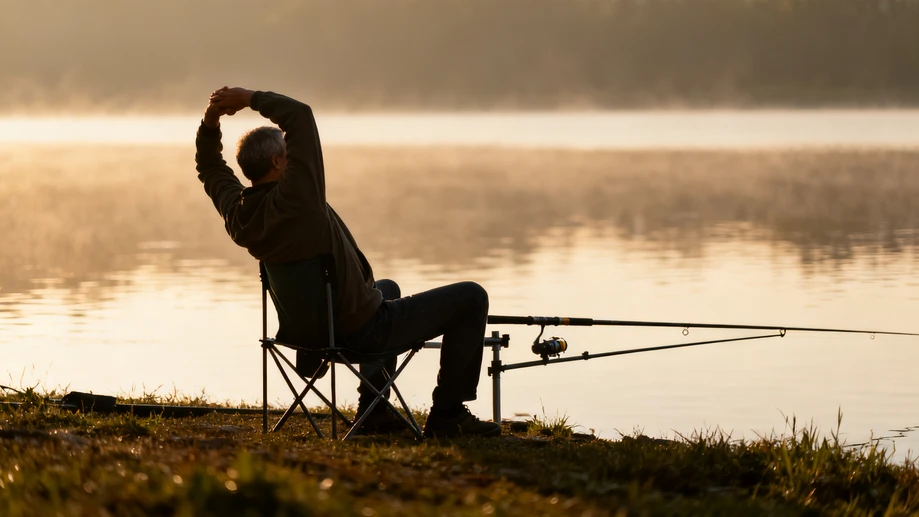
Consider the "Lure Limbering": After tying on a new fly or jig, instead of immediately casting, take ten seconds. Interlace fingers, turn palms outward, and push your arms straight up towards the sky, feeling the delicious pull from shoulders down to ribs. Hold. Breathe. Release. Or the "Reel Relief Rotation": While waiting for a bite, gently twist your torso from side to side, letting your gaze follow over each shoulder. Imagine you're slowly scanning the horizon for the *perfect* casting spot, all while lubricating those spinal joints. The "Tackle Box Tilt" is another gem. When bending down to rummage for pliers or sinkers, hinge carefully from the hips, keeping the back long, perhaps even bracing a hand on a knee. Hold the position for a beat longer than necessary – it’s a prime hamstring and lower back stretch disguised as tackle organization. These micro-movements are the angler's stealthy defense against stiffness.
The magic lies in consistency and context. Unlike a daunting hour-long gym session, these stretches are effortless integrations. They happen *because* you're fishing, not in spite of it. Each cast, each bait change, each patient wait becomes a natural trigger. Over time, this isn't just reactive movement; it evolves into a proactive habit as instinctive as checking the drag on your reel. You start anticipating the stiffness, stretching *before* it sets in deeply. The folding chair isn't just a seat; it becomes a prompt for seated spinal twists. Watching the bobber isn't passive; it's a cue for gentle neck rolls. This seamless weaving of movement into the beloved ritual is the key to making it stick. It transforms fishing from a passive hobby into an active, body-aware practice.
So, the next time you head out with rod in hand, pack your tackle, your patience, and your newfound stretching awareness. Embrace the pauses, the waits, the moments between action. Use them not just to watch the water, but to listen to your body and gift it small moments of release. You'll likely discover that the true prize isn't just the fish in the cooler (though that's nice!), but the remarkable absence of that familiar ache as you pack up your gear. You return home not just with stories of the one that got away, but with a spine that feels supple and muscles humming with contentment. The serene waters offer more than fish; they offer a surprisingly effective, utterly enjoyable path to keeping your body moving freely, proving that the best fitness routines are sometimes hidden in plain sight, disguised as pure pleasure.